
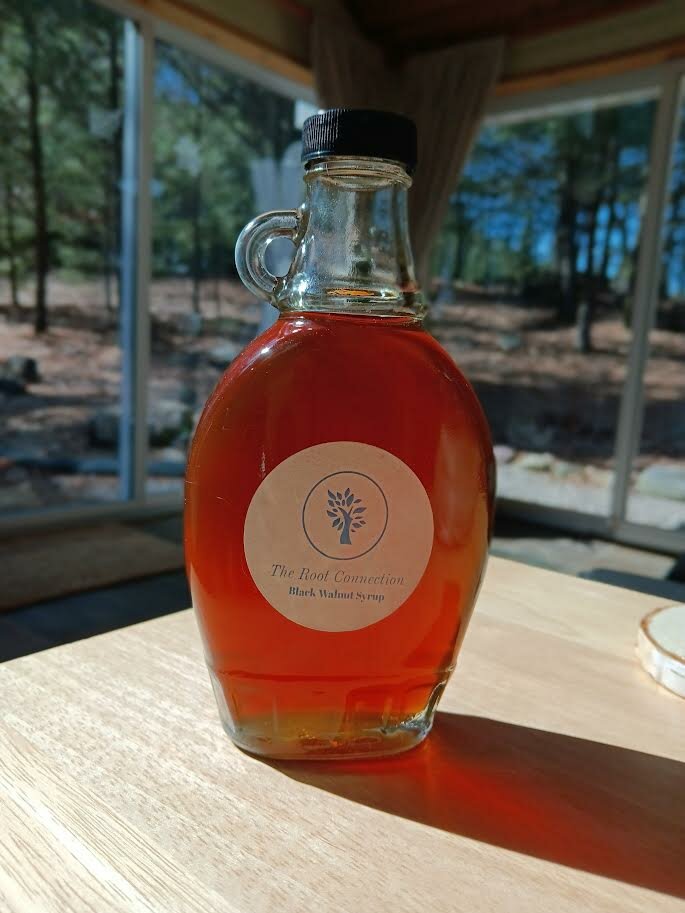
What’s up with all those hanging bags from trees throughout the county? The most common answer is “Maple syrup time!” Did you know you can also tap silver and red maples, hickory, birch, and box elder trees? But have you ever considered it being black walnut syrup time? I did not, but a small processor owned by Jordan Luck in Hancock called The Root Connection changed my thinking.
Timing is everything in this sweet endeavor. If you wait too long, you might miss the prime sap flow, and if you tap too early, the sap may not be ready. It takes a lot of trees, and not everyone has a love for the lowly Black Walnut tree.
Black walnut trees have to be at least 14 inches in diameter. Most homeowners have taken down trees by this time because of the stains black walnuts leave on the pavement and the myriads of walnut seeds making walking on the lawn precarious at times. Thus, finding enough trees in a yard to tap for enough sap.
How many gallons of sap are needed to produce a gallon of black walnut syrup? The ratio is not too different from that of maple syrup (40:1); in other words, approximately 40 gallons of sap are needed to make one gallon of syrup. This is close to 10 quarts of sap, which is boiled down to about 12 ounces of sweet black walnut syrup.
Not knowing what the syrup tasted like, my assessment revealed it is intensely sweet, with a flavor distinctly different from maple syrup, sort of earthy and nutty. I plan on trying it on pancakes and mixing it in my homemade fermented yogurt. I might even get ambitious and find a new dessert recipe.


Comments
No comments on this item Please log in to comment by clicking here